Brand & Design Library
Every specimen below is the live component rendering from the same tokens the site uses. Nothing here is a screenshot or a redrawing, so this page cannot drift from production. Change a token, and this page changes with it.
What is live, what is on screen, and what Peak still owes.
| Beat | Still | Clip | Source |
|---|---|---|---|
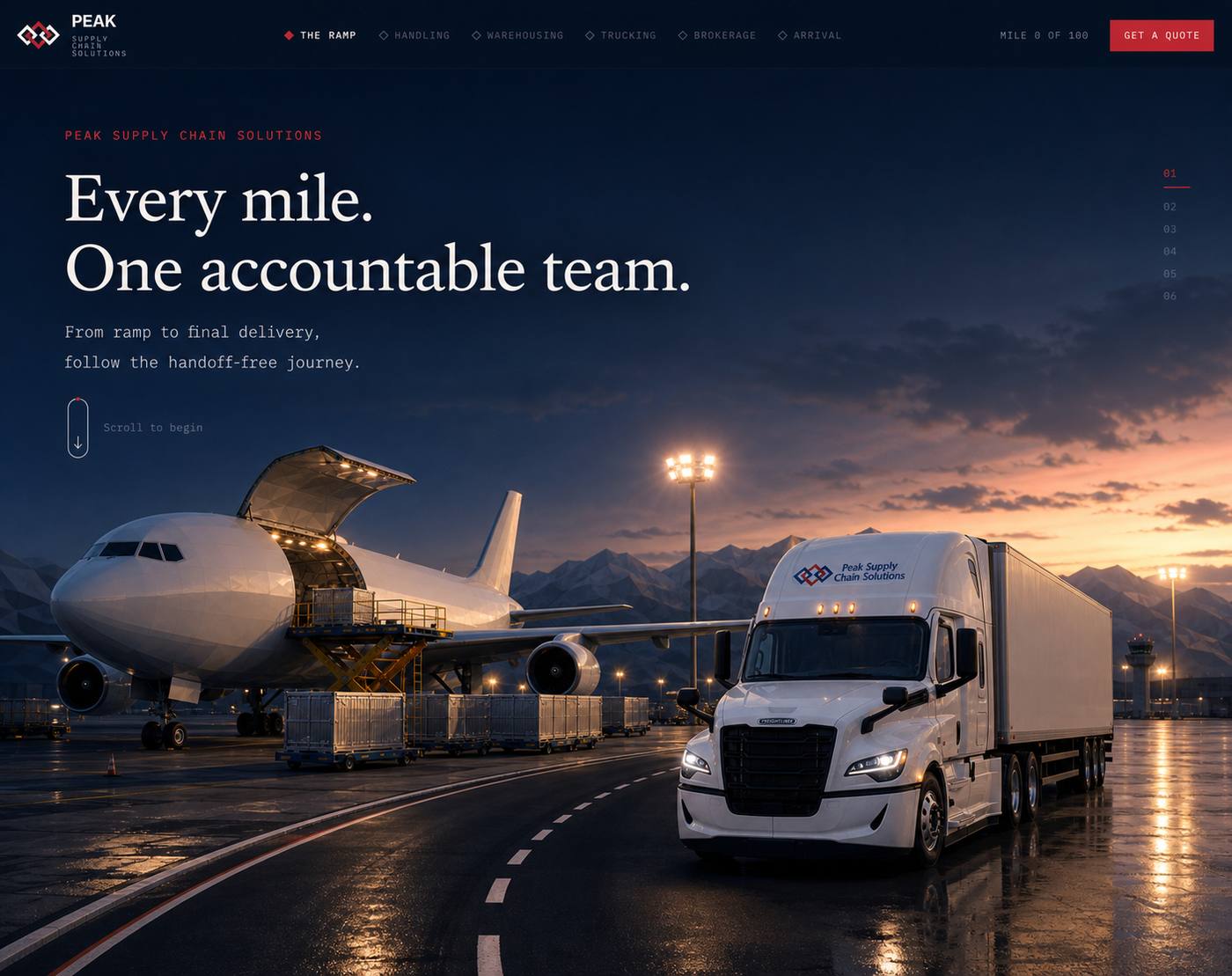
| Hero | Sunrise road, branded tractor | Road at sunrise, looping | Generated |
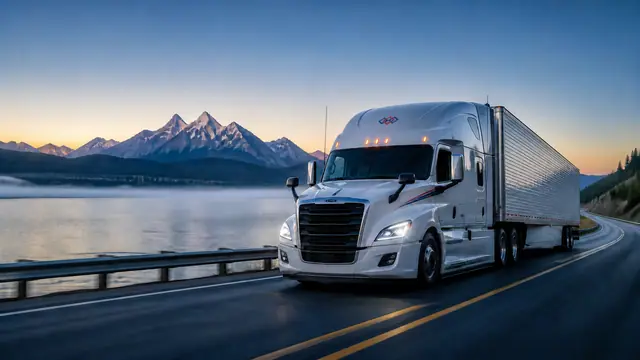
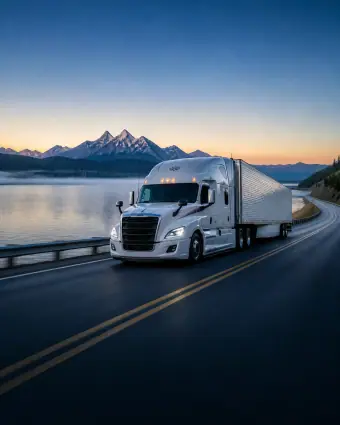
| 01 The road | Lakeside drive-by | Road, looping | Generated |
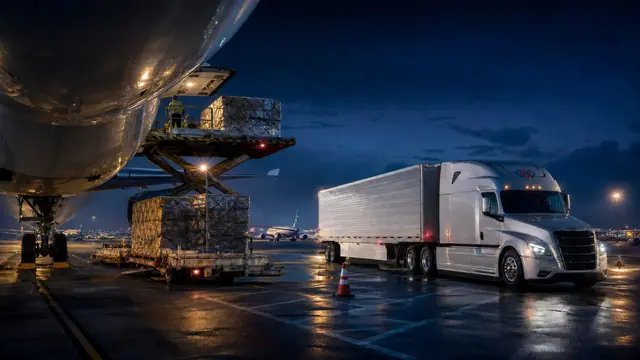
| 02 The ramp | Sunset tug and ULD train | airport_tarmac_sunset_1, looping | Peak |
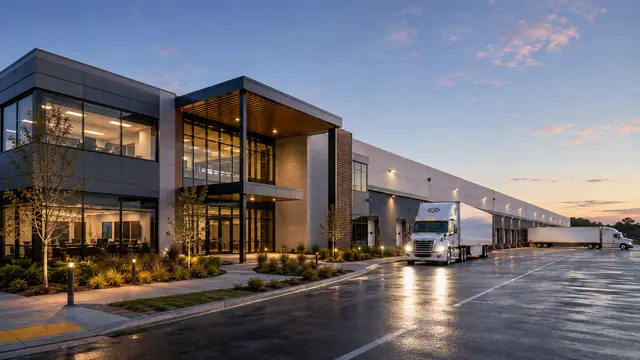
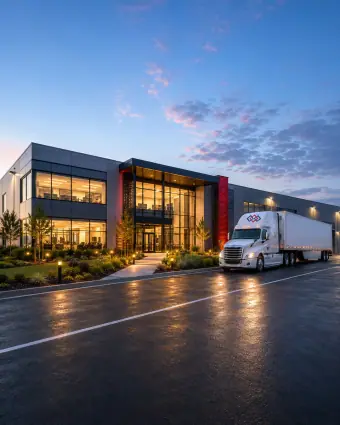
| 03 Home base, Louisville | Louisville cross-dock at sunrise, v07 | Dawn, looping | Generated |
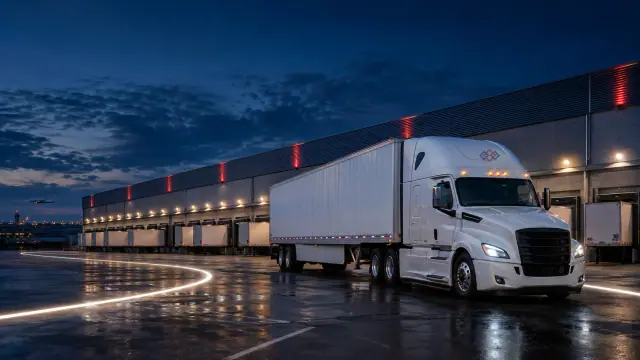
| 04 The dock | Cross-dock, v02 | Dock, looping | Generated |
| 05 Partner service | Operations room | Recovery, looping | Generated |
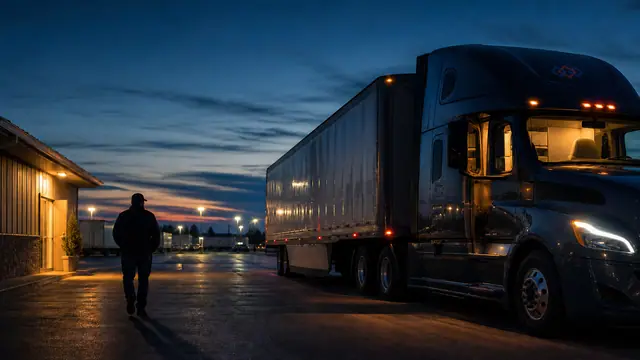
| 06 Driver home safe | Driver walking to the doorway | Arrival, looping | Generated |
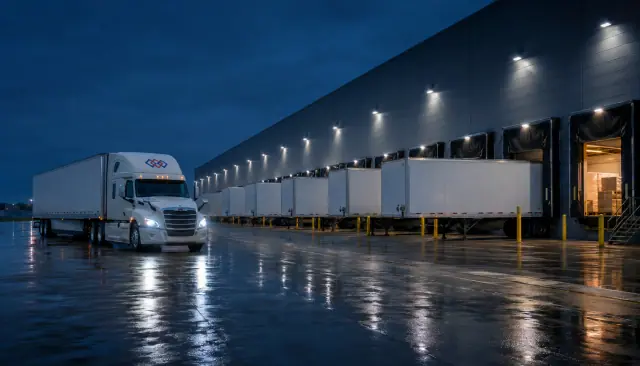
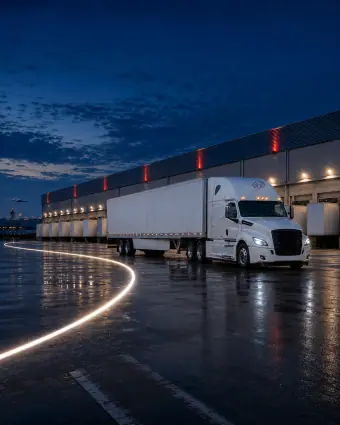
| 07 The loop | Night dock, marked tractor | semi_truck_timelapse, looping | Peak |
Peak means footage Peak supplied. Generated means art direction made for the site, to be re-made against Peak's footage over time.
- 01Post @Peaksuprecruitingbot connect in each terminal's recruiting chat, so applications route by terminal. Until then everything goes to Driver Recruiting.
- 02Rack card, before print: confirm the dispatch number and Chris Janes's direct line.
- 03Generated frames still to be re-made against Peak's real footage: the road, the dock, partner service, driver home safe.
Every quote, driver, warehouse and contact form posts to Peak's Telegram recruiting group within seconds and lands in the inbox at peaksup.com/admin, where it can be searched, marked read, archived and exported.
North Star
The strategy the whole system serves, from the website vision brief at docs/strategy/PEAK_WEBSITE_VISION.md. Peak has already built the operational company; every page, concept, and asset in this library exists to reveal the company the market needs to see.
Confidence that Peak can keep business moving.
The emotional outcome the site must produce in a prospective customer: “These people can handle this.” And in Peak’s own leadership: “This finally feels like the company we have become.”
Capability
Show what Peak can actually do. No generic language burying real operations.
Scale
Make the footprint tangible: locations, fleet, people, miles. Verified numbers only.
Reliability
Demonstrate how Peak communicates, responds, and keeps freight moving.
People
Family-owned and human-operated. Leadership, dispatch, drivers, all visible.
Proof
From trust us to here is why customers trust us.
- Regional trucking company→Growing, sophisticated supply-chain operator
- List of services→Connected operating capabilities
- Claims→Evidence
- Contact us→A clear path to solving a logistics problem
- VERIFIED_CURRENT
- Can sell today. Traces to a source and a date.
- VISION
- Can inspire. Always labelled, never claimed as current.
- IN_DEVELOPMENT
- Named as such until operationally verified.
- RESEARCH_REQUIRED
- Anything unverified. Renders as a pending marker, never estimated.
This is the vision brief and the Integrity section agreeing with each other: future-state thinking never becomes a public claim. The site says here is what Peak has built and here is where Peak is going, and never confuses the two.
Foundation
Peak is an air cargo ground network. It started in Louisville in 2019 handling air freight and grew outward along air cargo geography. In every market it operates, freight can come off an aircraft, be handled, stored, and driven out on a Peak truck without leaving Peak custody.
Off the aircraft, through the dock, onto the truck, without changing hands.
Presence
Owned ground inside the air cargo footprint of every market. Trucks are commodity; presence is not.
Accountability
A named chief per station. Escalation is a phone call, not a ticket queue.
Family owned
Founded 2019, still owner-operated. The owner's phone number is published.
Logo
Three interlocking diamonds, navy and signal red, drawn as an alternating chain weave. The geometry is measured from the original brand asset, not approximated: outer diamonds carry a 183 half-diagonal at 65 stroke, the centre diamond 257.4 at 73, all three on a shared baseline spaced 242 apart.
Knockout · dark grounds · the default in both apps
Full colour · light grounds




The left diamond passes over the red on its top-right edge and under on its bottom-right. The right diamond does the reverse. Do not simplify it to a flat stack; the weave is the mark.
It is drawn in three passes: red, then both navy over it, then red again clipped to the two quadrants where it belongs on top. Repainting individual edges instead leaves a notch at the vertices, because a two-point line has butt ends cut square to its own direction and cannot fill a mitered corner.

- Full colourLight grounds onlyDownload SVG
- KnockoutDark and photographyDownload SVG
- White, as suppliedBrand navy onlyDownload SVG
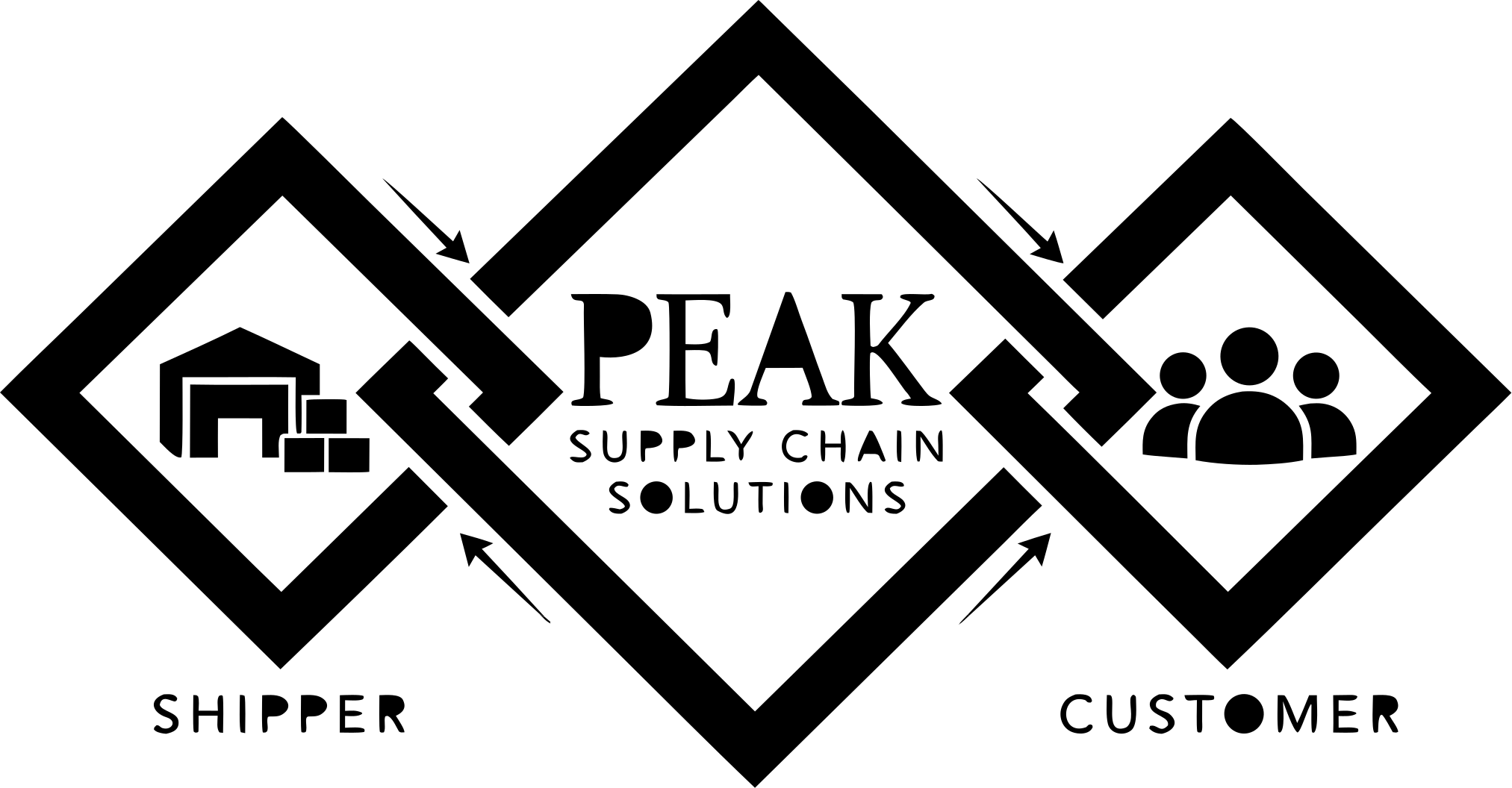
The chain already in the mark, read as linkage: shipper to Peak to customer. The weave is the argument. Freight passes through Peak without the chain breaking.
This is Peak’s own vector file, with the type already outlined. It replaced a reconstruction that stood in here while only a raster was available. Send this to a print vendor rather than letting anyone redraw it: a redrawn version puts a second, slightly wrong identity into circulation, which is how a brand quietly stops being one.
Navy and red on light grounds only. Against ink the navy measures 1.10:1, so the outer links disappear and only the red centre survives. On anything dark, use the knockout below.

As supplied · plate behind PEAK
Derived knockout · ground shows through
The white file Peak supplied is not a knockout. Its letter counters and the gaps in the icons are opaque #081D38 shapes painted on top of the white, so the mark only sits correctly on a ground within a few percent of that navy. Put it on ink, on navy-700, or over a photograph and a navy plate appears behind PEAK. It is visible above on the left.
The knockout on the right is derived from those same paths rather than redrawn. The supplied artwork becomes a luminance mask over a single filled shape: white paints, the navy counters fall to roughly one percent alpha and read as real holes, and the two greys in the pallet keep their shading as partial alpha. It takes currentColor, so it inherits whatever colour it is placed in.
Use the knockout for every dark ground and every photograph. Use the supplied white file only on the brand navy, and prefer the knockout even there.
The knockout is the only variant that survives this. It needs a scrim: an ink/55 wash holds the mark legible without flattening the photograph into a block, and it keeps the counters reading as counters rather than as noise.
- Header, mobile
- 24px tall
- Header, desktop
- 28px tall
- Absolute minimum
- 20px tall, mark only
- Clear space
- One diamond width on all sides
- Wordmark
- Inter Tight Semibold, two lines
Use the mark in paper and signal red on ink. Drop the wordmark below 640px and let the diamonds carry it.
Do not set the wordmark in the display serif. It was tested at 16px and goes soft against dark; it stops being legible.
Colour
The heritage navy and red survive as ancestry. The single biggest change from the old identity: red drops from decorative to signal only. It marks live stations, primary actions, and alerts. Nothing else.
Base canvas. Every page sits on this.
1.1:1 · DecorativeSame value as the canvas since Aug 2026. Surfaces use Navy 800.
1.1:1 · DecorativeBrand navy, carried from the original mark.
1.5:1 · DecorativePrimary text and the light half of the logo.
16.7:1 · AASecondary text, ledes, long body copy.
12.5:1 · AATertiary text, labels, and every hairline at 22%.
7.2:1 · AAPrimary action, live station, alert. Used sparingly.
3.2:1 · AA LargeOperational status, positive confirmation.
3.8:1 · AA LargePending or awaiting data. Never an error.
6.3:1 · AARed for the one action you want taken on a page, plus live-station markers.
Red as decoration, red for headings, red for borders on ordinary cards. The old site used red everywhere and it stopped meaning anything.
Typography
Newsreader for display, Inter Tight for interface, IBM Plex Mono for data. Chosen because Peak's deficit is credibility, not novelty: an editorial serif buys perceived age for a company that is only six years old.
display-xl · opsz 72
display-lg · opsz 60
display-md · opsz 42
display-sm · opsz 24
Lede. Handling, warehousing, and asset-based trucking in 16 markets, under one roof.
Body. Asset-based means the truck is ours and the driver is ours. When a window is at risk there is no carrier to call.
Small print and helper text.
4603 Allmond Ave, Suite 2, Louisville, KY 40209
Layout
The system is built on 1px steel hairlines at 22% opacity. Cells sit on a hairline background with a 1px gap, so the rules are the layout rather than borders drawn onto each cell.
- wide
- 1440px max, used for most pages
- default
- 1180px max
- prose
- 68ch, legal and long-form
- Gutter
- 20px / 32px / 48px
- --radius-xs
- 2px · buttons, tags
- --radius-sm
- 3px
- --radius-md
- 4px · maximum
Components
Live instances. Every one of these is imported from the same module the production pages import.
Rendered when a figure is not published.
- Tractors
- 2016 to 2023 day cab and sleeper
- Dry van
- 53ft, swing door and roll-door
- Specialized
- 53ft roller-bed trailers
Used anywhere Peak has not published a figure. Deliberately conspicuous. The absence is the message.
Helper text sits under the control.
Drawn rather than sourced, so the silhouettes are accurate to what Peak operates. The ULD is a trapezoid because air cargo containers have a slanted face, and the tractor is a day cab pulling a 53ft box rather than a delivery van.
Everybody has trucks. Almost nobody has the ground.
Ledes run to roughly 58 characters and sit in bone, one step down from paper.
Data & Maps
The network map is pure SVG rendered on the server from Albers USA coordinates precomputed at author time. No tile provider, no API key, no client JavaScript, no layout shift, and roughly 6.5KB of path data.
- data/stations.ts
- 16 markets, 8 live, transcribed from /locations
- data/services.ts
- 3 divisions, with verbatim source quotes
- data/company.ts
- Leadership, verified facts, pending proof
- data/careers.ts
- Driver pay, transcribed from /drive-for-peak
- data/photography.ts
- 17 shots, 14 filled
Photography
Peak's website carries no photography of its operation, but Peak does own photography. Some of it was on Instagram, and five more frames of their own tractors were supplied directly. Those run full colour. The front door now runs a generated branded set instead of graded stock — eight frames, each authored twice: a wide master for the web and a portrait frame composed for a phone. Licensed placeholders still fill slots elsewhere and are graded to the brand duotone so borrowed frames read as one set. The shot list below is the real fix.
Real
Peak's own photography
Documentary record: their trucks, docks, people. Runs full colour, never graded, and is the only register allowed to prove a claim.
Stylized
The drawn and 3D world
The low-poly drive, diagrams, the map. Authored in brand palette, obviously illustration, carries story and mood.
Generated
AI imagery, as illustration
Allowed in the mix where it is clearly illustrative. The premium branded set (Aug 25) carries the mark on cinematic renders and holds the front door; generated frames still never depict a named person and never stand in for the documentary record.
The site mixes all three deliberately as you move through the product. The one hard line, held over from the collateral audit: a generated frame presented as a photograph of Peak’s actual fleet, people, or facilities is a fabricated record, and it does not ship. Generated imagery earns its place by being honest about what it is.
Web · the wide masters, 1680×960



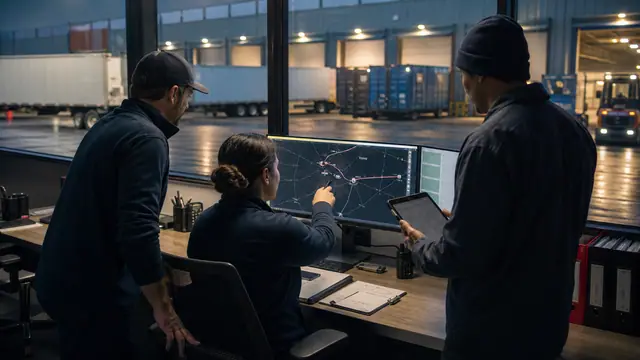
Phone · composed for the box, never cropped into it

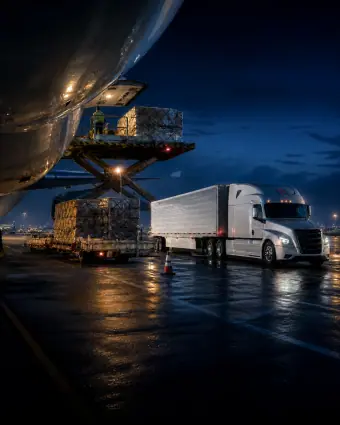

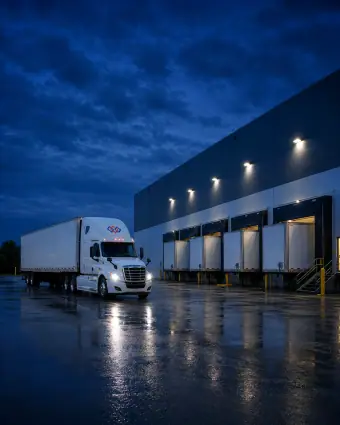
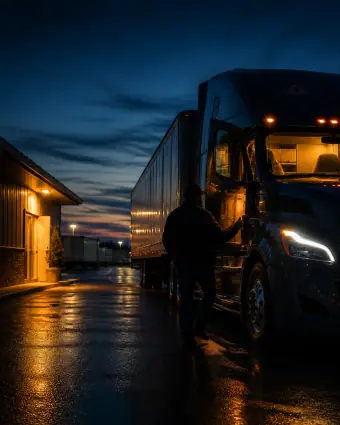


Live on the front door · eight frames, sixteen files · desktop pulls 793 KB, a phone 946 KB · shot list at vision/peak-visual-system · earlier register at §15 Reference Library
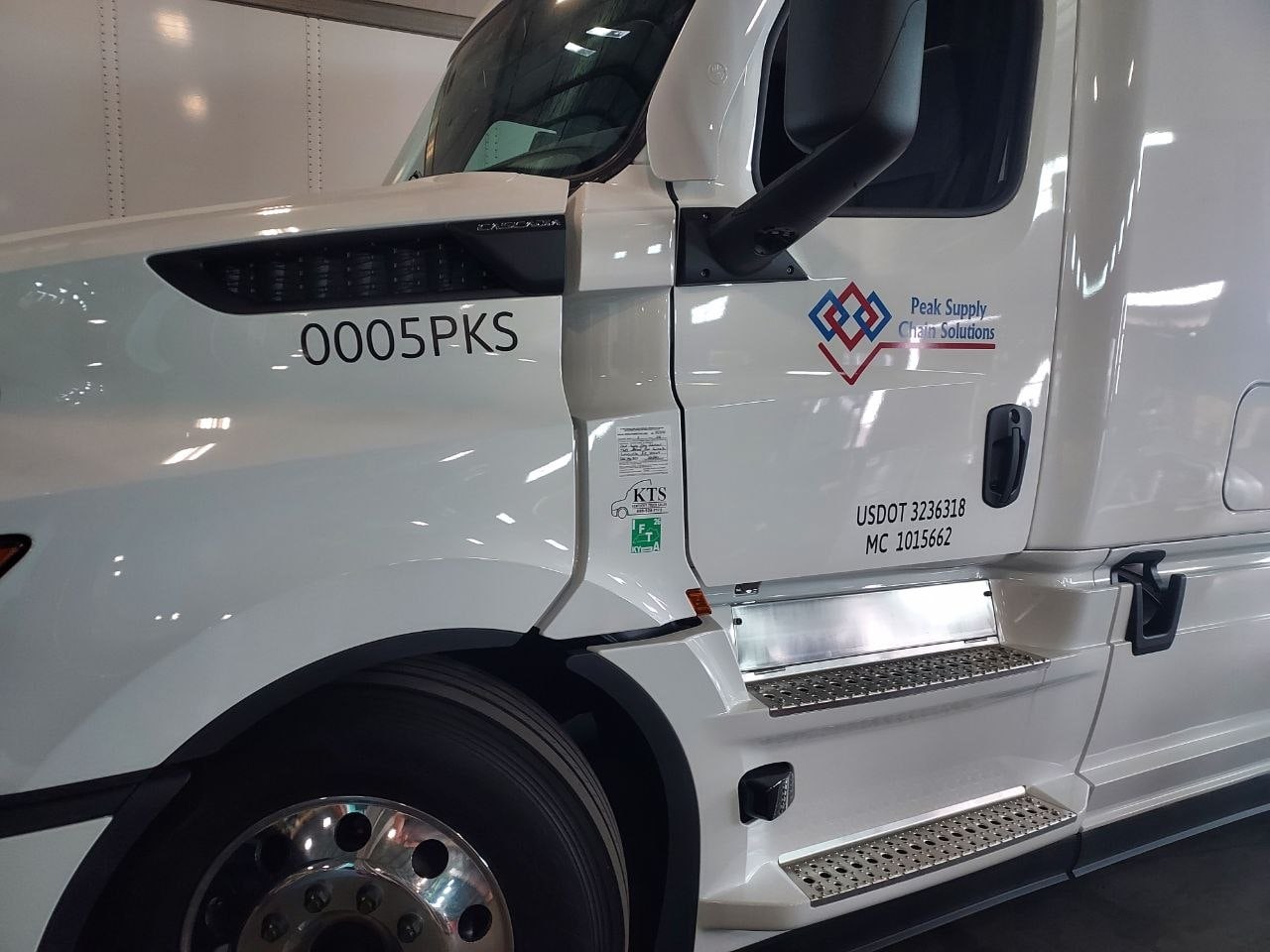
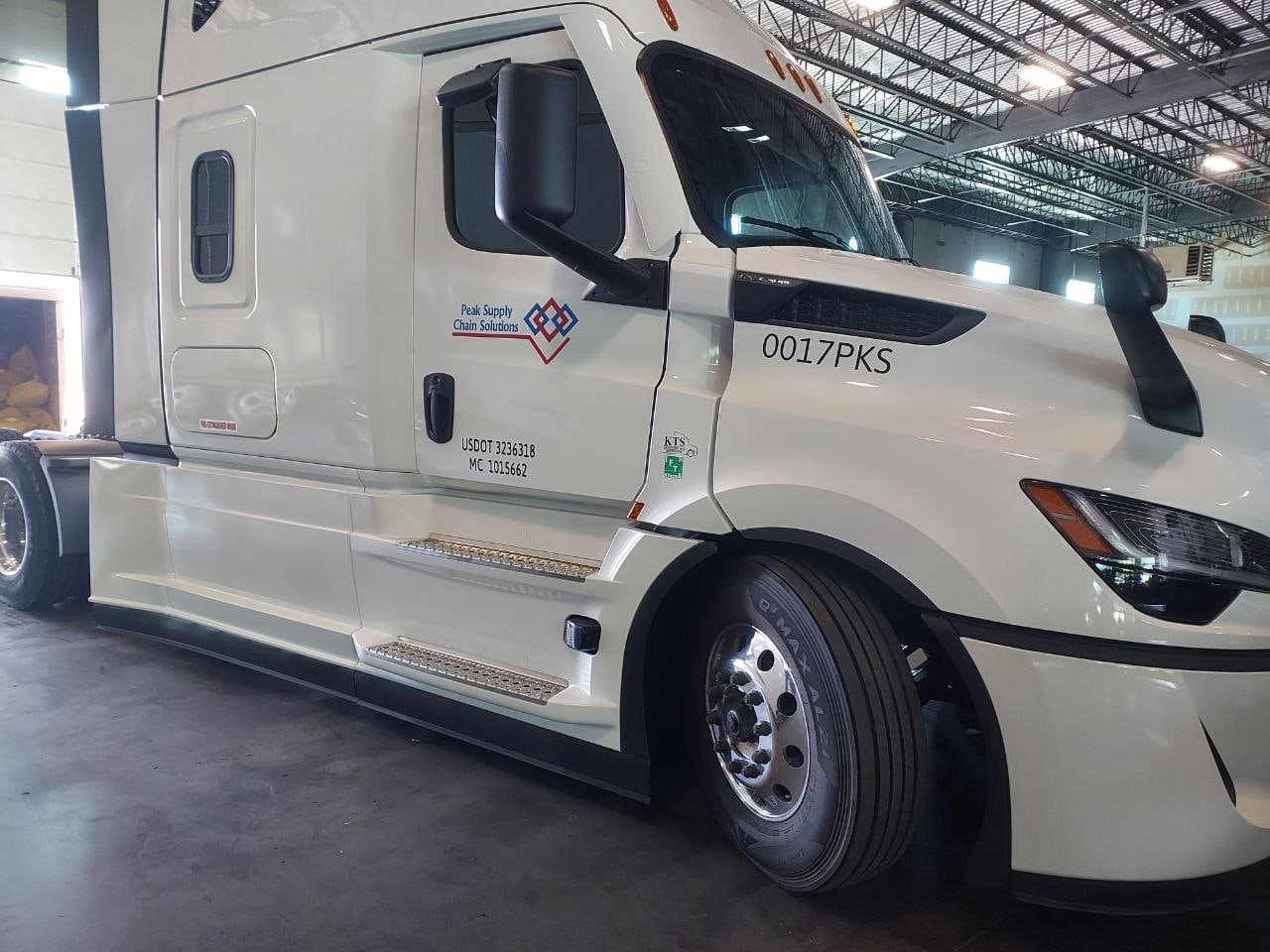
The duotone exists to make borrowed stock read as one set. Peak’s own tractors carry the navy and the red of the mark on the door, so they already belong to the palette. Grading them would desaturate the one thing in frame that is genuinely Peak’s in order to help a licensed dock photo sit next to it, which is the wrong way round.
The rule: Peak’s equipment runs full colour, stock runs graded. A frame that shows a Peak logo is never duotoned.
- peak-unit-0005pks.jpg
- 1280 x 960 · any slot
- peak-unit-0017pks.jpg
- 1280 x 960 · any slot
- peak-truck-night.jpg
- 1408 x 1760 · any slot
- peak-truck-sun.jpg
- 1408 x 1760 · any slot
- peak-fleet-dusk.jpg
- 617 x 228 · narrow band only
- peak-fleet-lineup.jpg
- 600 x 229 · narrow band only
- peak-fleet-sunset.jpg
- 507 x 401 · held in reserve
A frame cannot be used above its native width. The three fleet shots arrived around 600px wide, which is a third of a full-bleed slot on a laptop and less than that on a retina screen. Upscaling adds no detail, it only makes the softness bigger, so those three are held out of the site rather than shipped soft.
This is not a treatment problem and no filter fixes it. The originals will exist at full size wherever they were exported from. Ask for those, and the fleet lineup becomes the one frame on the site that shows the fleet as a fleet.
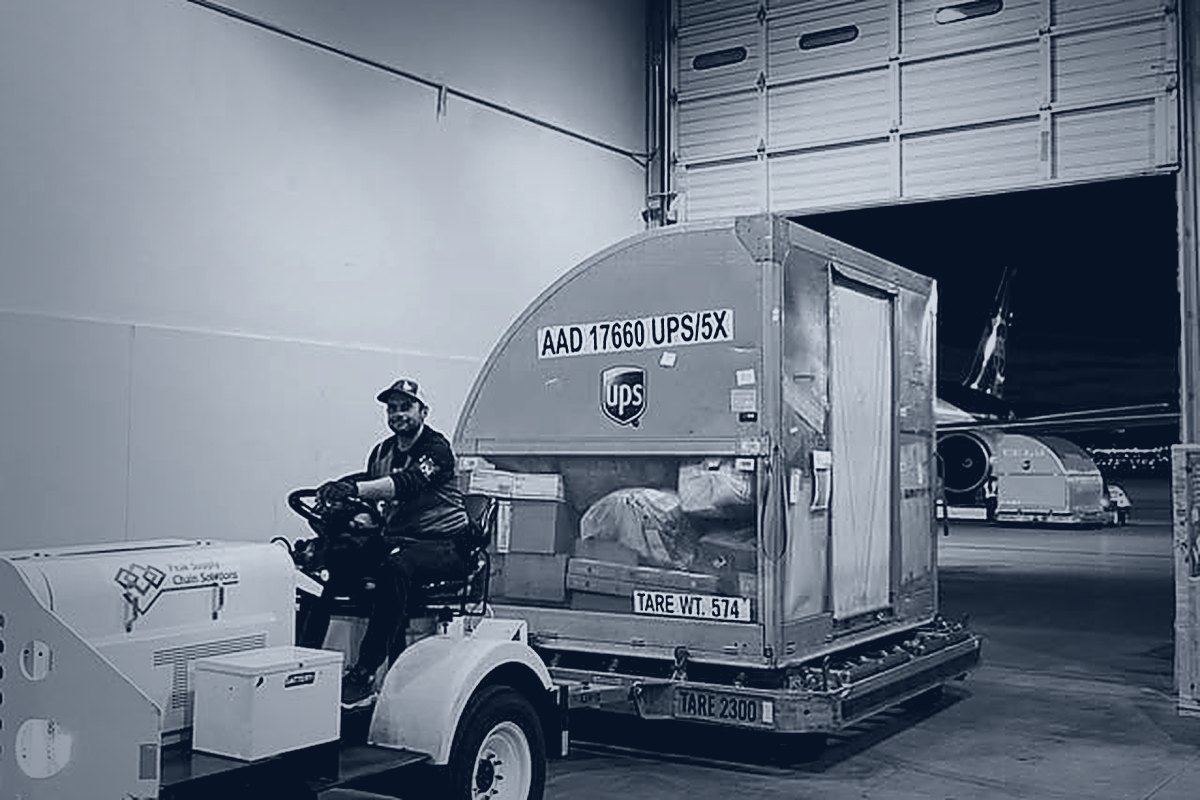
Frames are colour-graded at export using a true gradient map from ink to a cool paper highlight, not a CSS filter. A gradient map holds tonal detail that a grayscale-plus-tint approximation destroys, and it means the shipped bytes are already correct.
Grading at export is also what lets a phone shot taken next week and a commissioned frame taken next year read as one set.
Any station
Klaus and Seth together, standing in a facility rather than in front of a backdrop. Not posed at a desk. This frame is the entire family-owned claim, and right now that claim rests on a sentence with nothing behind it.
This is what an outstanding commission looks like in the system. It renders here because the style guide asks for it. On a customer facing page the same slot renders nothing at all, so production notes can never leak into the site.
Available light, during a real shift. Wide enough to show the building. Everyone named in the caption.
Flash, staged smiles, scheduled photo days, or any frame where the subject will not be named.
- P1Air cargo handlingPeak dockPlaceholder in place
- P1Homepage, opening statementSDF, LouisvillePlaceholder in place
- P1About, ownershipAny stationMust be shot
- P1Air cargo handlingPeak trailerPlaceholder in place
- P1Asset-based truckingPeak rampPlaceholder in place
- P1Station pages, one per marketAll eight stationsMust be shot
- P2WarehousingLargest available facilityPlaceholder in place
- P2Drive for PeakPeak rampPlaceholder in place
- P3Trucking, dispatchSDFMust be shot
- P1Asset-based trucking, Drive for PeakPeak facilityPlaceholder in place
- P1Asset-based trucking, Drive for PeakPeak facilityPlaceholder in place
- P1Drive for PeakPeak yardPlaceholder in place
- P1Asset-based truckingPeak yardPlaceholder in place
- P2Fleet scale, narrow band onlyPeak yardPlaceholder in place
- P3Fleet scale, narrow band onlyPeak yardPlaceholder in place
- P3ReservePeak yardPlaceholder in place
- P3Cross-dock, warehousingAny stationPlaceholder in place
Frames depicting a specific Peak person or a specific piece of Peak equipment stay empty until they are shot. A stranger from a stock library cannot be captioned Sean Thomas, Station Chief, and a generic trailer cannot prove a 53ft roller bed. Those four slots are marked Must be shot above.
Motion
Two kinds of motion, and a rule. Route pulses on the network map are decorative and switch off under reduced motion. The homepage story beats and the hero play short clips over their stills, looping, fetched only as each frame approaches. The rule, Peak's since September 15: every beat leads with its words, then its picture, so no two moving frames ever touch.
- Where
- The hero and the seven homepage beats; page headers where a clip exists
- Behaviour
- The still is on screen first; the clip fades in over it when it can play, and loops
- Files
- story-v01/<beat>-w.mp4 for desktop, <beat>-m.mp4 for phones, a frame-0 poster beside each
- Encode
- Audio stripped, H.264 CRF 29, faststart; recipe in public/video/story-v01/README.txt
- Loop seam
- A clip that ends on a hard cut gets its last second dissolved into its first, so the wrap does not snap
- Bytes
- Nothing loads until a frame is 200px away; a clip pauses the moment it leaves the screen
- Reduced motion, Data Saver
- The still, and no fetch at all
- 02 The ramp
- Peak's sunset tug clip over Peak's sunset still
- 07 The loop
- Peak's night-dock timelapse over a frame of the same take
- Everything else
- Generated art direction, to be re-made against Peak's footage
- Paths
- pathLength=1, so one keyframe fits every arc
- Duration
- 4.5s linear, infinite
- Stagger
- 0.62s per leg
- Reduced motion
- Pulses removed, arcs held at 0.4 opacity
- Colour transitions
- 200ms
- Surface hover
- bg-navy-800/50
- Focus ring
- 2px navy-300, 2px offset
- Form guide bar
- Slides up 300ms on the ease-out-expo curve; progress line 300ms
Voice
Peak's own writing is better than most agency copy. The standard is set by their line about handling every package as if it were a grandmother's glass vase. Write toward that, not away from it.
Concrete and physical. Off the aircraft, through the dock, onto the truck.
Abstract capability language. Leveraging end-to-end supply chain solutions.
Quote Peak verbatim where their sentence is better. Attribute it to the page it came from.
Paraphrase their best writing into something blander.
State the limit. Dispatch sits in Louisville.
Round a fact up to sound bigger. Dispatch sits in Louisville and Albuquerque.
Commas, colons, and full stops.
Em dashes. Not anywhere, including code comments.
Contact & communication
How Peak is reachable is a design decision, not an IT decision. The phone tree, the website, and the brand promise all have to say the same thing, and right now they do not.
- Dispatch
- Dispatch managersOperational hours, the busiest branch
- Sales & new freight
- President of Business DevelopmentBusiness hours
- Safety & compliance
- V.P. of HR, Safety & SecurityBusiness hours
- HR & careers
- V.P. of HR, Safety & SecurityBusiness hours
- Maintenance
- Fleet maintenanceOperational hours
- Shop
- Shop floorOperational hours
These six branches come from the IVR Peak specified for CloudTalk. They are effectively the first published statement of how the company is organised, which makes them worth getting right.
Vanity number
A US number ending PEAK (7325), subject to availability. Memorable in a category where nobody has one.
Existing number stays live
Long-standing customers keep dialling what they already know. Nothing breaks on cutover.
IVR self-routing
Six branches so a caller reaches the right desk without a human relay.
AI receptionist
Out-of-hours and weekend cover: FAQs, messages, routing, 24/7.
Call recording & transcripts
Visibility across dispatch. Also the raw material for finding what callers actually ask.
Roughly 200 calls a day
Against 150 tractors and 300 trailers. The volume is what makes this worth solving.
Let the AI receptionist take messages and answer hours, location and status questions out of hours, then hand off to a named person by name.
Let it answer for a named station chief during working hours. Peak's entire promise is "you get a name, not a queue". An AI queue at 10am contradicts the thing being sold.
The current site routes new freight to two personal mobile numbers, the owner’s and the EVP’s. That was flagged in the audit as unscalable, and the CloudTalk project is Peak reaching the same conclusion independently.
When the tree goes live, the site’s contact architecture should mirror it exactly: the same six branches, the same names, the same hours. A caller and a visitor should meet the same organisation. Two different maps of one company is how a brand starts feeling unreliable before anyone can say why.
Keep the direct numbers for the 4 named leaders. That is a genuine differentiator and the tree should not bury it.
Fleet counts and call volume come from a vendor’s recap of a discovery call, not from Peak directly. They are marked unconfirmed in data/company.ts and must not appear on a public page until Seth confirms them.
They are worth confirming quickly. 150 tractors is real scale, and the current site describes the fleet only by model year.
Content integrity
These rules exist because the first draft of this site broke all of them. Louisville was described as the largest air cargo hub in North America, which is Memphis. A dispatch manager was assigned to a city he is not published in. Station chiefs were given a promotion history that does not exist.
- 01
Every fact traces to a source
If it is not on peakscs.com or supplied by Peak, it does not ship. Source paths are recorded in the data files.
- 02
No claims about competitors
Most carriers this size do not own roller beds is unverifiable. Describe Peak's equipment and stop there.
- 03
No invented people or history
Names, titles, and locations come from the locations page. Nothing is inferred about careers or tenure.
- 04
Absence is visible, not filled
Unpublished metrics render as a pending marker. They are never estimated, rounded, or quietly omitted.
- TSA IAC / CCSF
- Unstated. Strongest credential if held.
- Network size
- Peak claims 10 cities; 8 have published addresses.
- Service metrics
- None published. Six slots pending.
- Form delivery
- /api/inquiry validates and logs only.
- Privacy policy
- Drafted, not reviewed by counsel.
Collateral
Print is produced here, not only checked here. The library holds the marks, the palette, the faces, the photography and the company record, which is everything a printed piece needs — so a piece is generated from those and comes out print-ready rather than being drawn somewhere else and audited on arrival afterwards. Both happen below: the standard every piece obeys, the register of pieces, and the reviews of work that arrived from outside.
Bleed
0.125in on every edge the artwork touches. A background or graphic must LEAVE the page — one that stops inside the trim reads as a mistake once it is cut.
Quiet margin
A further 0.125in inside the trim that no type crosses, because the guillotine has a tolerance and a name clipped in half is not recoverable.
Resolution
600dpi for small format. Generated at final size, never scaled up afterwards.
Type minimums
Nothing below 6pt. Body 7.5–8.5pt, a person’s name 11–16pt. Sizes are authored in points, not fractions of an inch, so an unreadable value is obvious while it is being written.
Colour
Files are RGB. Digital presses take them as-is; a litho house wants CMYK, and Signal #c8102e must be matched rather than auto-converted — the naive conversion turns it muddy.
Nothing that counts
No market totals, headcounts or dated figures. A printed piece cannot be redeployed: the day the number changes, every copy in every wallet is wrong. Print what stays true.
Generated, not drawn
A piece reads the company record the website reads, so a title or an address is corrected in one place and rebuilt. Redrawing is how a printed set ends up disagreeing with the site.
One mark, one weave
The mark comes from the vector in §02. No second badge, no redrawn approximation, no generated cab decal standing in for the real thing.
| Piece | How it is made | State |
|---|---|---|
| Executive business cards | Generated from data/company.ts by scripts/build-cards.mjs. Four fronts and a shared back at 600dpi with bleed. | Print-ready |
| Driver recruiting card | Front carries the mark, a recruiting line and a code to the driver page; back carries the published pay seats, read from data/careers.ts. | Print-ready |
| Trifold brochure | Supplied as images from outside. Audited claim by claim below rather than reproduced. | Audited, not adopted |
| Rack card, September 2026 | Rebuilt from the record: sixteen markets named on the front, titles and lines as the site publishes them, peaksup.com on the back. HTML source in rack-card/, PDF re-rendered from it. | Print-ready once Peak confirms the dispatch number and Chris Janes's line |
| Prather rack card | Supplied print piece. Twelve errors found against the record; the corrected contact line is the one now carried elsewhere. | Superseded |

One card per executive plus a shared back, at 600dpi with bleed. Every front is generated from data/company.ts — the same record the website reads — so a title correction is a data edit and a rebuild rather than a designer reopening a file. That gap is how a printed set ends up disagreeing with the site about someone’s job.
Three trifold drafts were supplied as images: a light interior spread, a navy back-panel layout, and a navy cover layout. The copy discipline is better than the rack card was. The verdicts below are per claim, against the data files.
| Claim on the piece | Against the record | Verdict |
|---|---|---|
| Call 502-792-9177 | Matches the verified line from the corrected rack card. | Checks out |
| MC 1015662 · USDOT 3236318 | Match credentials in data/company.ts exactly. | Checks out |
| 4603 Allmond Ave, Louisville, KY 40209 | Published address is 4603 Allmond Ave, Suite 2. The suite is dropped. | Incomplete |
| Warehousing locations in 10 cities | Matches Peak's own claim, verbatim from their site. Nine have published addresses. | Peak's claim |
| 10+ warehousing locations | The plus inflates Peak's own number. Ten is the claim; ten-plus is not. | Overstates |
| Safe. Reliable. Responsive. Every Mile. | Appears in no Peak source. Invented tagline. | Invented |
| Driven to Deliver, star badge | Appears in no Peak source, and the badge is a second mark. One brand, one mark. | Invented |
| Strong FMCSA CSA scores | CSA scores are public but have not been pulled. Unverified until they are. | Unverified |
| Fleet photography | Generated trucks. Cab decals show the mark with the wrong weave and colours. | Replace |
The pattern to keep: contact block, credentials and services copy are usable nearly as-is. The pattern to stop: invented taglines, invented badges, and generated fleet photography with a wrong mark on the cab door. Peak has real photography and a real vector mark in section 02; there is no reason for a print piece to carry approximations of either.
The source images are not in the repository yet. Drop the print files into website/public/collateral/ and they will appear here on the next sync, alongside this audit.
The journey system
The Drive concept is a hundred-mile scroll from the 0400 ramp to the dusk dock, and this section is its system of record: the chapter model the scene, narration, and wayfinding all read from one file, and the rules that keep every view full-screen on desktop and phone.
| Chapter | Miles | Headline | Receipt |
|---|---|---|---|
| The Ramp04:00 · THE RAMP | 0–14 | Presence before daylight. | A truck sent later is a vendor. An operation already here is Peak. |
| HandlingOFF THE AIRCRAFT | 14–30 | Into Peak hands. | Custody starts here. It doesn't change again. |
| The DockONE ROOF · ONE OPERATION | 30–50 | Through the dock. No vendor seam. | Freight can land, sit, re-sort, and roll out without a single phone call to anyone outside the building. |
| The RoadPEAK TRUCK · PEAK DRIVER | 50–70 | Onto the truck. Same team, now moving. | Our truck. Our driver. Your freight never meets a stranger. |
| RecoveryWHEN THE PLAN CHANGES | 70–86 | Peak stays on it. | And escalation is a phone call to a person, not a ticket in a queue. |
| ArrivalFINAL DELIVERY | 86–100 | Delivered. Never changed hands. | Tomorrow it starts again. Same crew, same promise. |
The page opens flat and aerial — a 2D map of the airport with the runway running off-frame, read from 160 metres up, starting in the clouds. Scroll dives the camera into a chase seat behind the truck; each chapter’s set piece owns its stretch of road; the closing miles lean the lens toward the warehouse yard so the drive visibly ends at the dock; and the network reveal traces the same roads the truck just drove. Portrait rotates the aerial so runway, apron, and highway stack along the tall axis — the phone never gets a cropped desktop frame.
Narration is typography composed into the scene: serif display headline, sans body, the receipt as an italic line on a signal rule. Legibility comes from shapeless vignettes and per-letter shadows — never a panel. Desktop places the column in the chapter’s calm zone; phones get a gradient-backed bottom sheet capped at 38% of the viewport. The header carries only navigation: mark, wayfinder, mile counter, and the quote pill. There are no in-page motion toggles — the operating system’s reduced-motion preference governs, holding golden hour and making chapter jumps instant.
The live build is at /concepts/journey, and the copy fields in the table above are the only narration the page is allowed to render.
The Reference Library
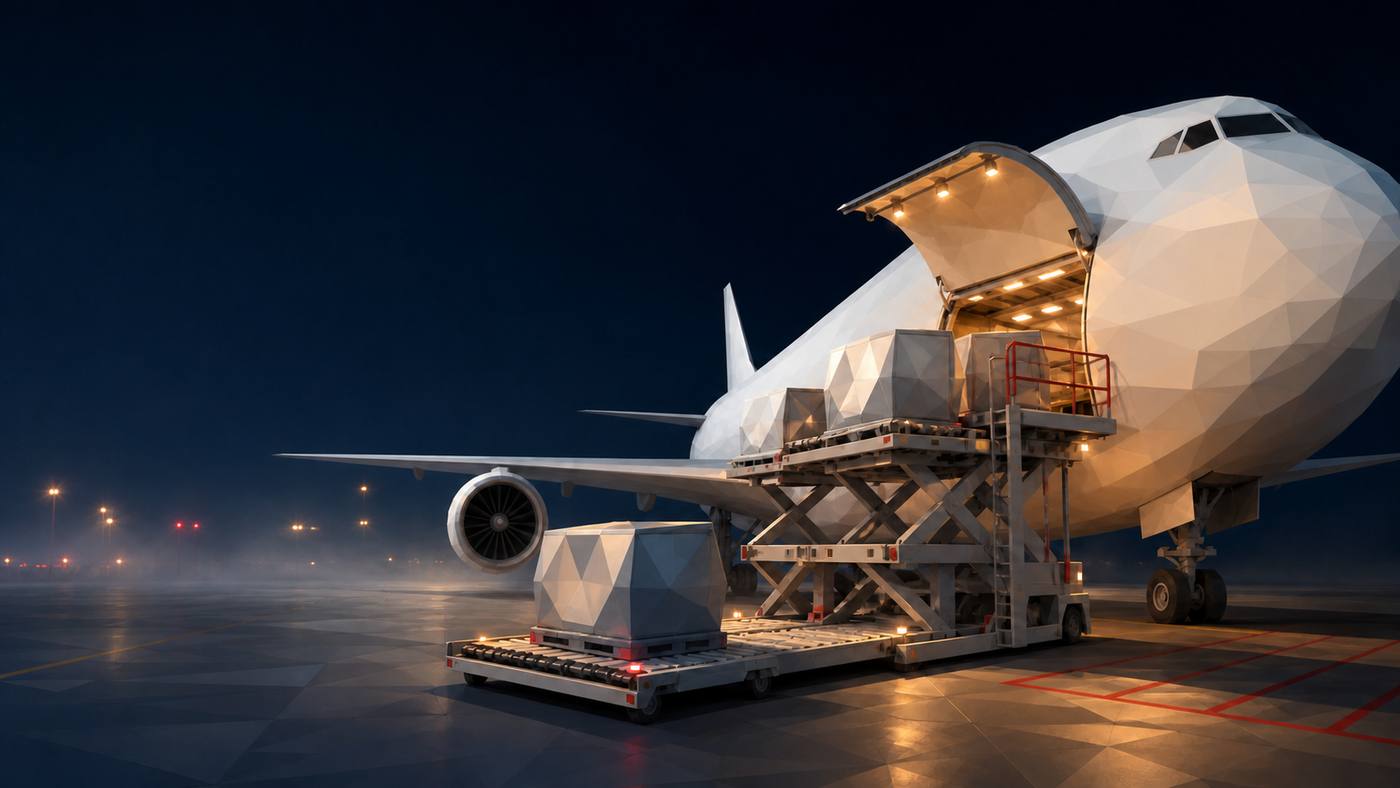
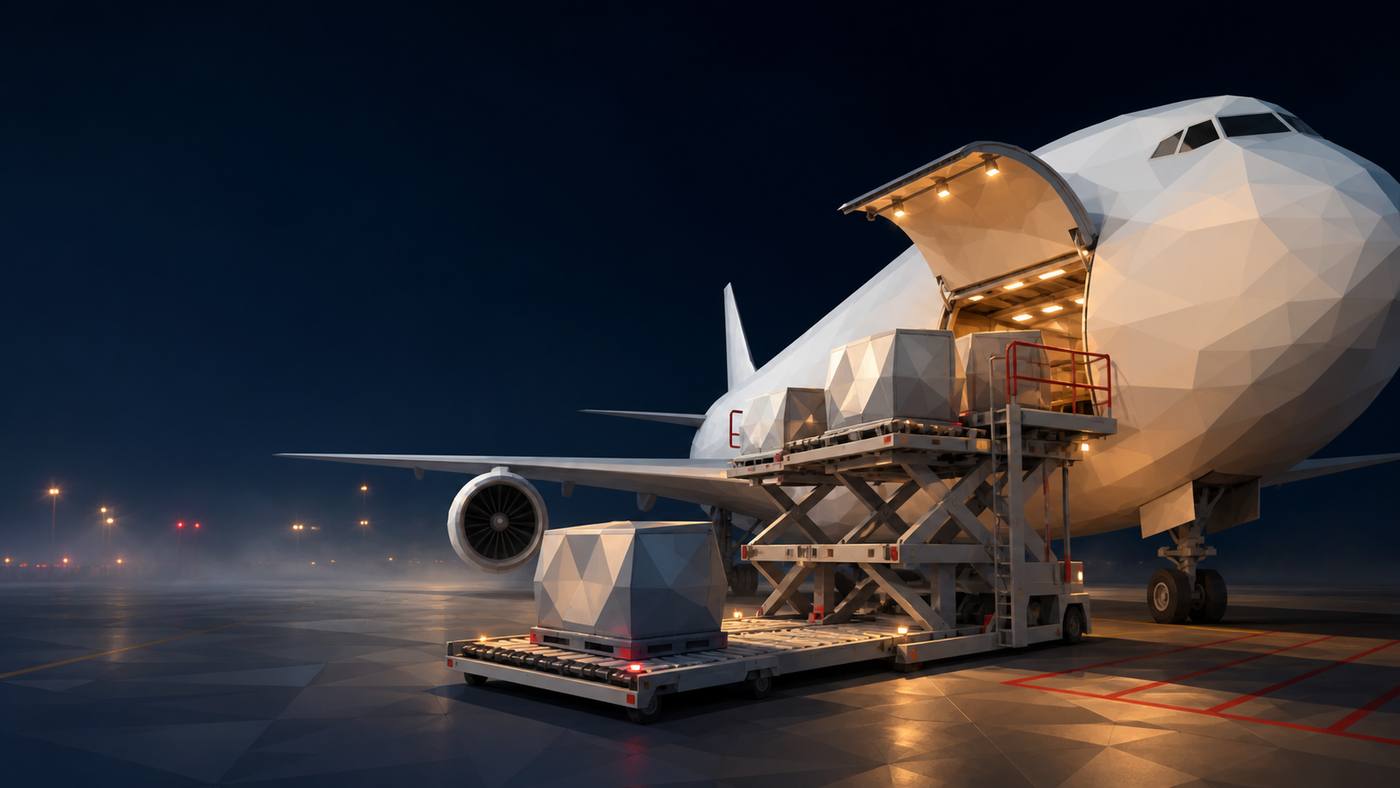
18 curated frames of the client's own generated art direction — the source imagery mined into The Drive's low-poly world, into The Reel concept, and into the site's share cards. Register rule: production-usable in the stylized register, always compressed, never presented as real fleet photography. The full mined build order is docs/peak-journey/ART_DIRECTION_SPEC.md.
- /og/drive.jpg
- The Drive · Open Graph share card
- /journey/poster-ramp.jpg
- The Drive · ramp chapter, WebGL / reduced-motion fallback poster










Next Rev
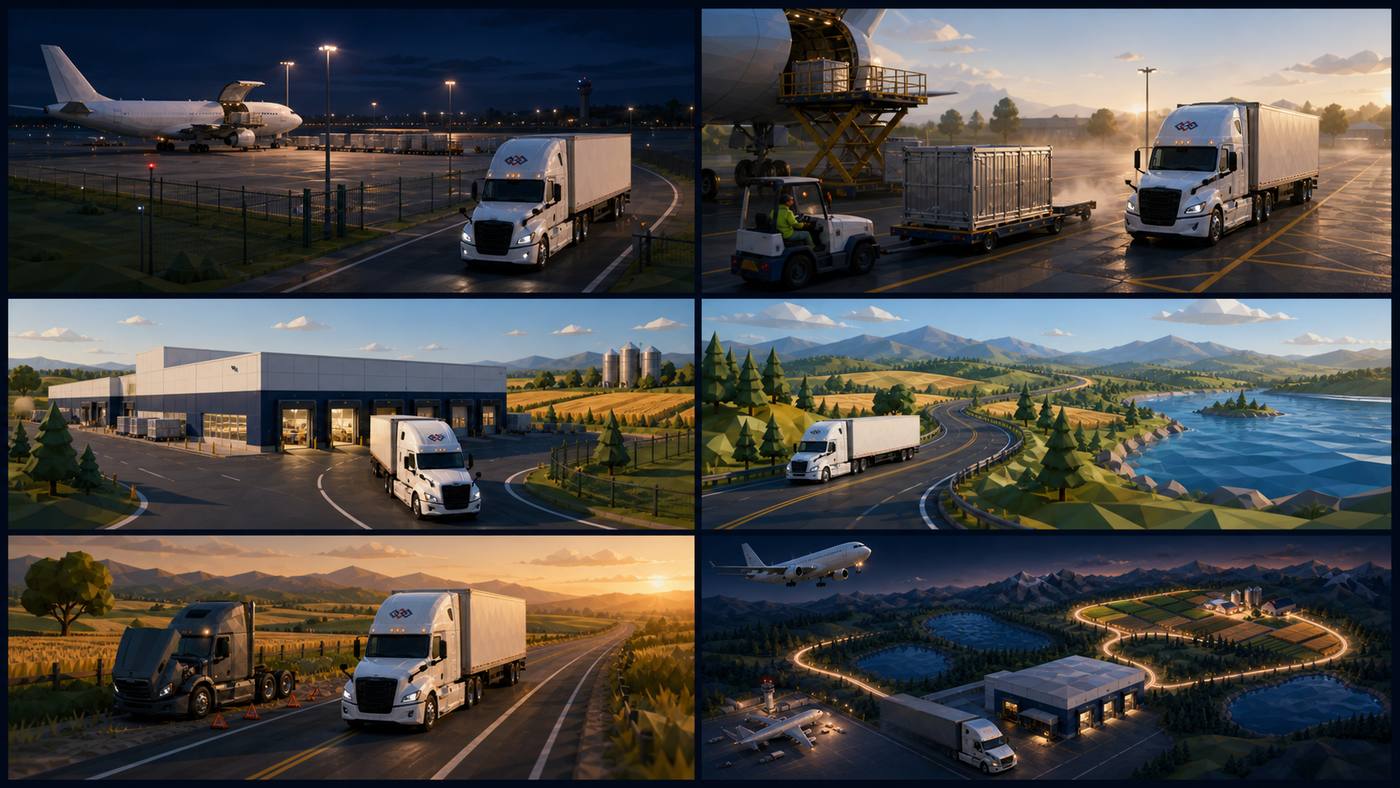
10 frames in premium-photo-story-v01, the branded premium photo-story pass now staged for the website and ready for Grok Imagine video production. This is the current indexed version before motion replaces the stills.






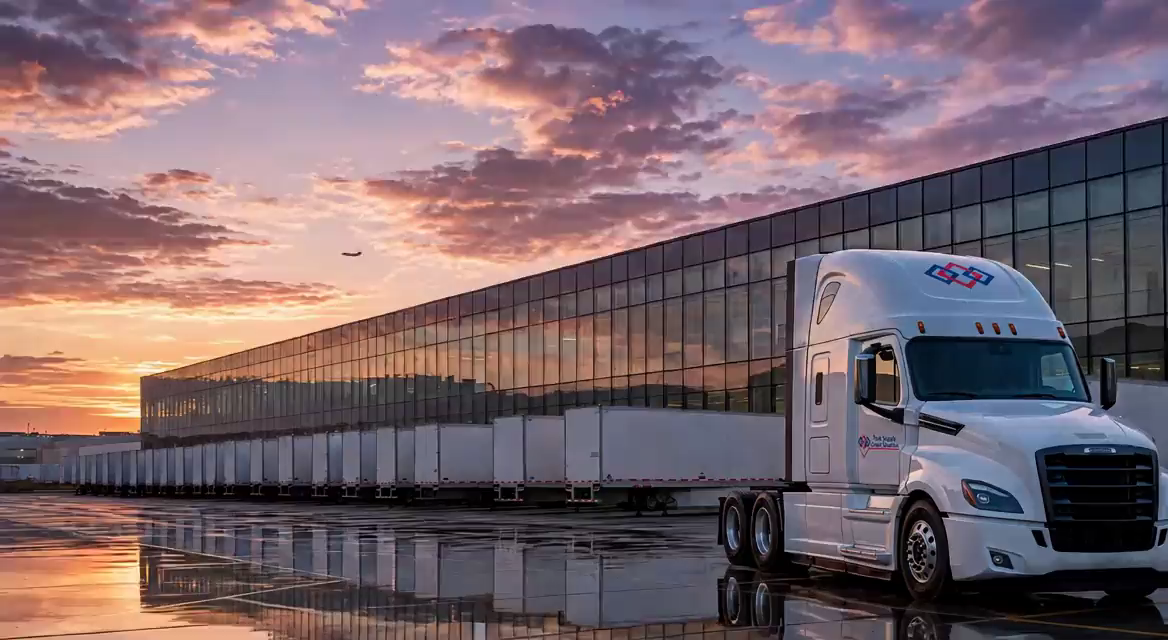

- Hero
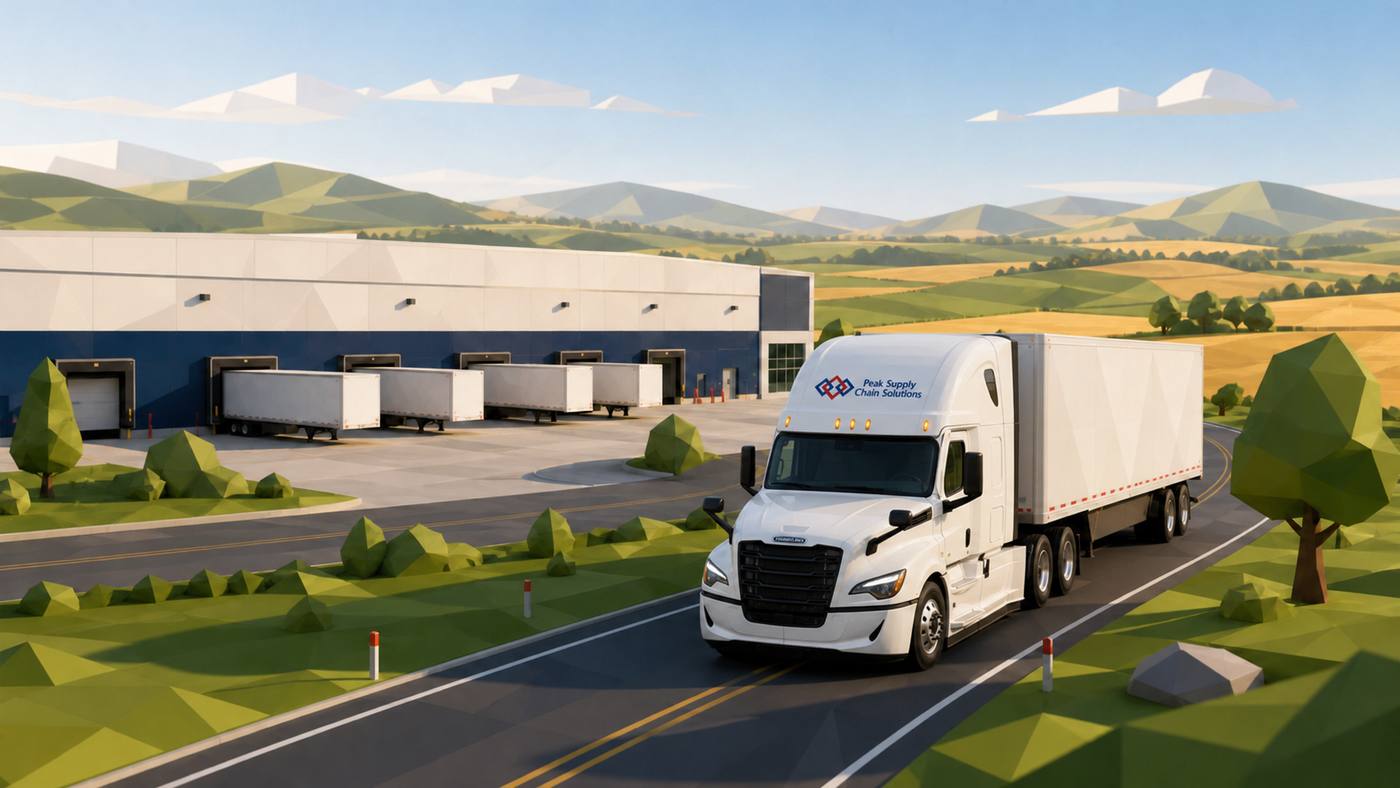
- Road branded still
- The road
- Lake drive-by with Peak mountains
- The ramp
- Air cargo transfer
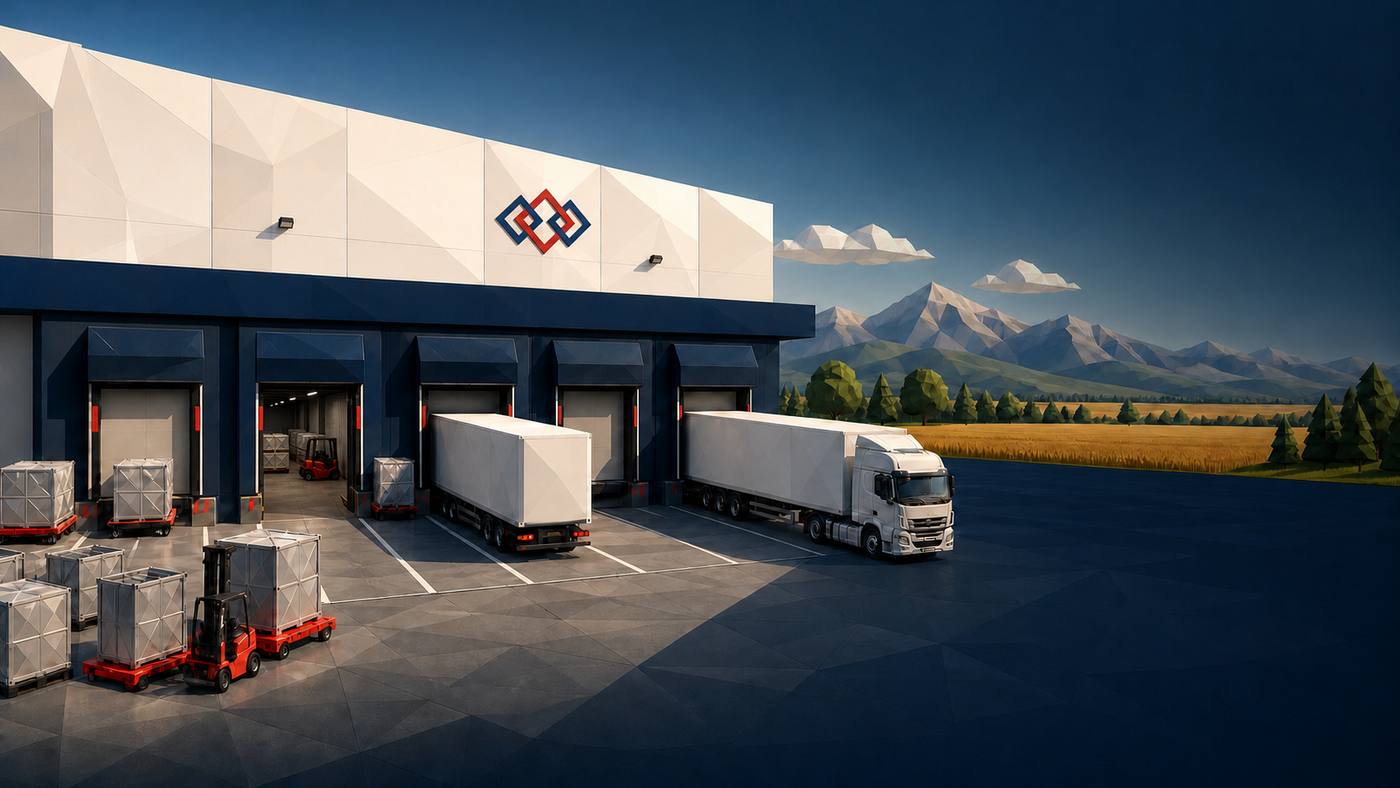
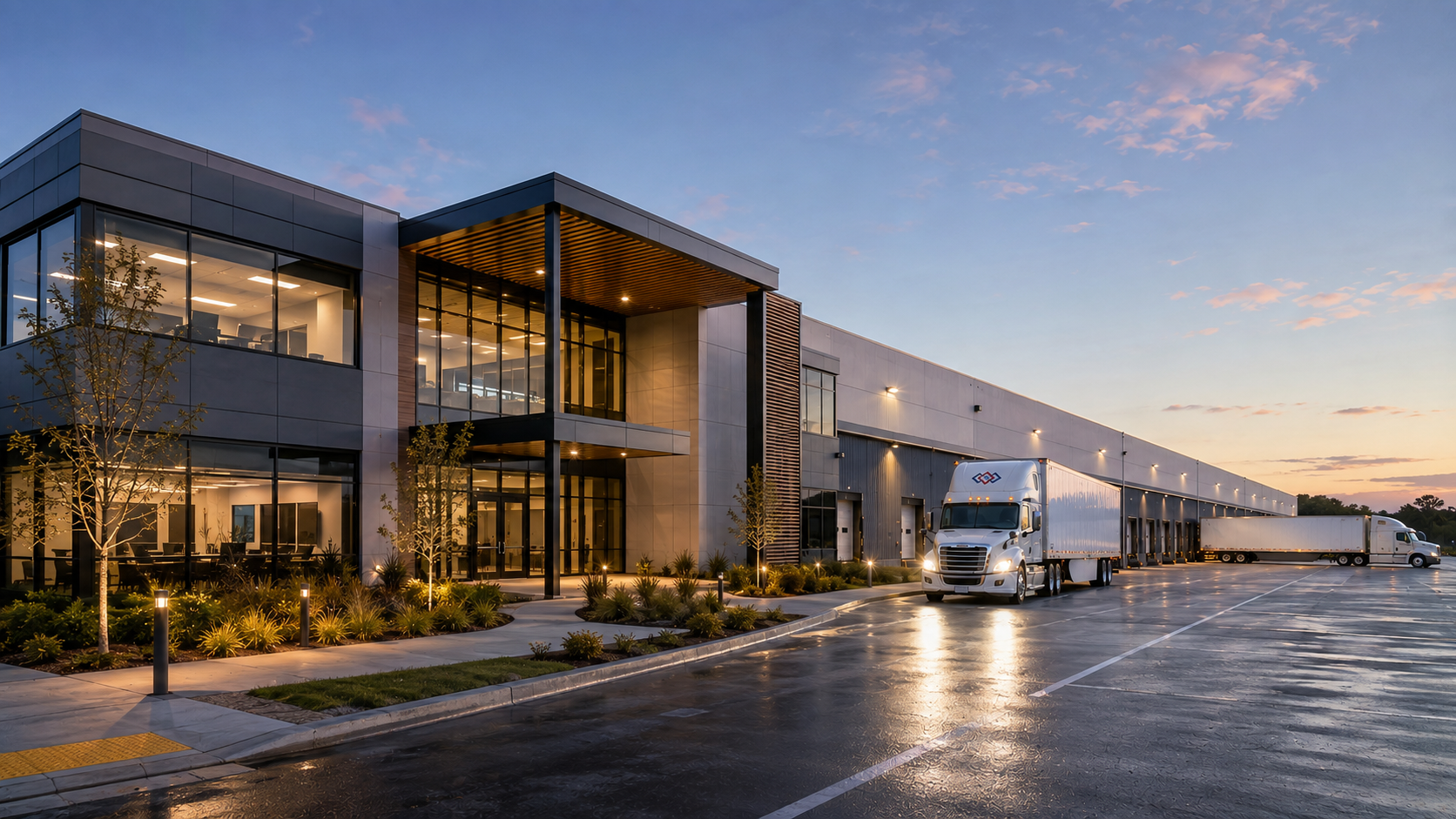
- HQ leveled up
- Modern HQ and cross-dock
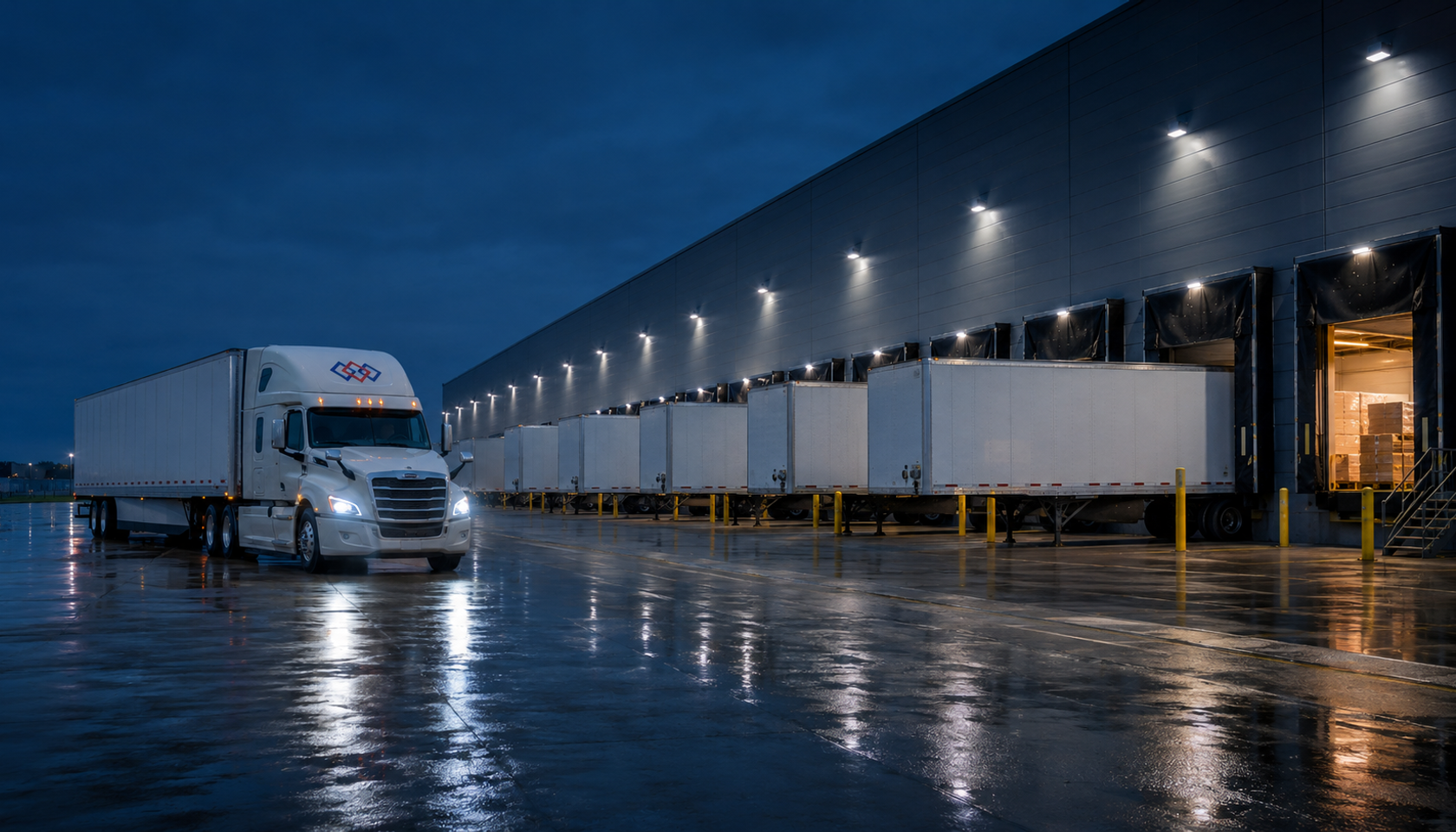
- The dock
- Blue-hour cross-dock reliability
- Partner service
- Operations-room coordination
- Driver home safe
- End-of-shift care
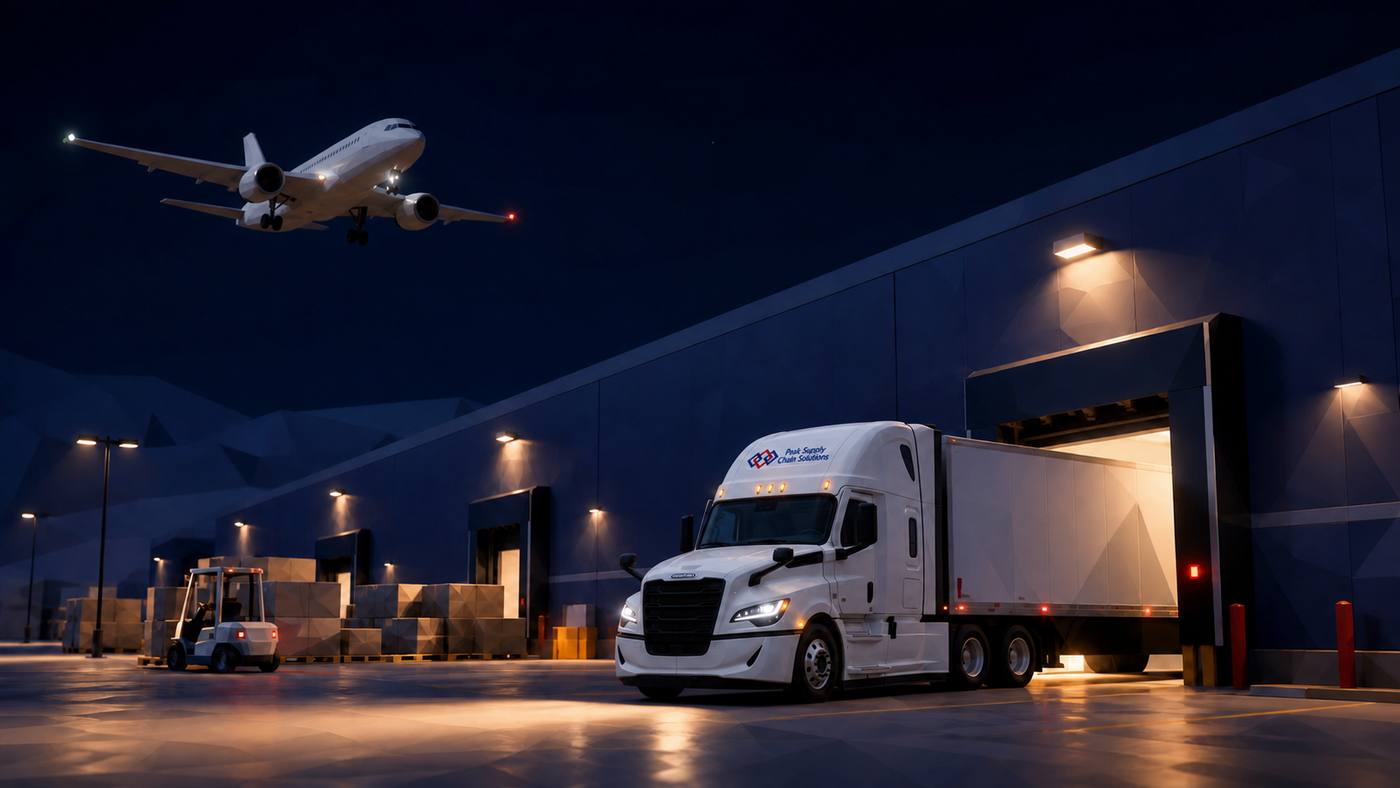
- The loop
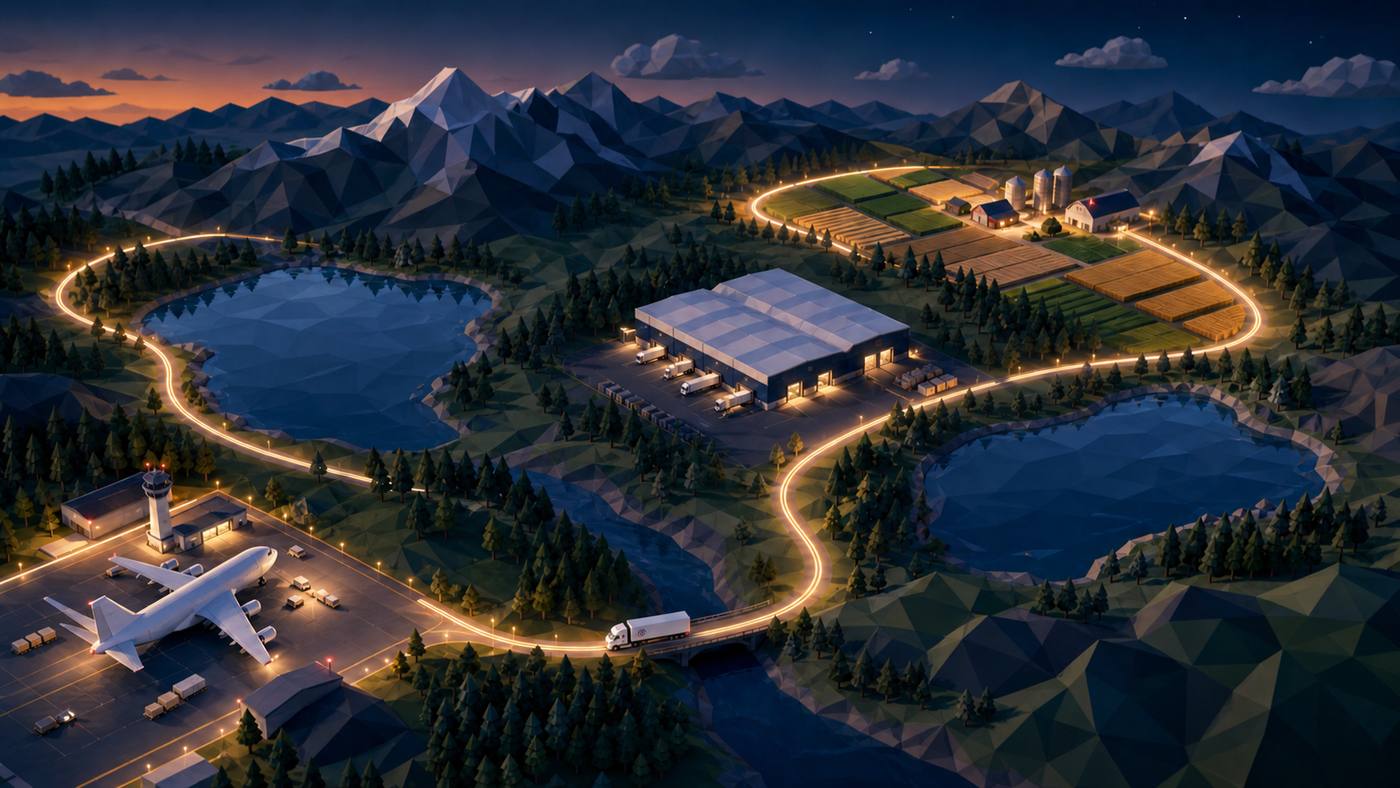
- Facility loop with route line
The road
Slow tracking drive-by from front three-quarter angle at dawn. Keep the tractor-trailer, cab roof mark, road geometry, and quiet blue-hour lighting consistent. If legible at this scale, place the exact company name Peak Supply Chain Solutions next to the roof mark as a small painted lockup. Add only natural road motion, subtle tire spray, marker-light glints, and a soft horizon parallax. No signage, no logo changes.
The ramp
Pre-dawn cargo-ramp motion. Hold the same aircraft, loader, cargo pallets, and branded tractor placement. If legible at this scale, place the exact company name Peak Supply Chain Solutions next to the roof mark as a small painted lockup. Add slow loader lift movement, small ramp-light shimmer, distant aircraft beacon glints, and faint tarmac reflection movement. No other readable text, no new logos, no fantasy airport details.
The ramp, sunset tug
Not for generation. Peak supplied the clip; this still is a frame of it.
The dock
Slow lateral push across a blue-hour cross-dock. Preserve the dock doors, aligned trailers, branded tractor, and wet pavement. If legible at this scale, place the exact company name Peak Supply Chain Solutions next to the roof mark as a small painted lockup. Add subtle forklift silhouettes in the far bays, warm dock-light flicker, and tiny reflection movement. No readable dock numbers, no new signage, no extra branding.
Driver home safe
Quiet end-of-shift moment. Keep the driver seen from behind, the warm doorway, the parked branded tractor, and dusk mood. If legible on the visible cab surface, place the exact company name Peak Supply Chain Solutions next to the roof mark as a small painted lockup. Add a gentle walk cycle, slight cab-light glow, and subtle pavement reflections. No identifiable face, no sentimental staging, no other text.
HQ leveled up
Premium HQ establishing shot at blue hour. Preserve the realistic office frontage, attached cross-dock, truck court, and subtle branded tractor marks. If legible at this scale, place the exact company name Peak Supply Chain Solutions next to the most prominent roof mark as a small painted lockup. Add a slow architectural push-in, warm office light variation, and restrained truck marker-light movement. No readable building signage, no corporate-campus exaggeration.
Lake drive-by
Cinematic lake-road drive-by at dawn. Keep the branded tractor-trailer, safe road geometry, lake, mist, and mountain peaks as the main composition. If legible at this scale, place the exact company name Peak Supply Chain Solutions next to the roof mark as a small painted lockup. Add smooth forward motion, water shimmer, light mist drift, and subtle mountain parallax. No tourist-postcard drama, no dangerous road, no other text.
The loop
Controlled facility-loop motion. Preserve the branded tractor, cross-dock facility, parked trailers, aircraft cue, and luminous route line. If legible at this scale, place the exact company name Peak Supply Chain Solutions next to the roof mark as a small painted lockup. Animate the route line as a thin restrained pulse, add light rain reflection movement, and keep the camera nearly locked with a slight push. No readable signage, no cyberpunk neon.
The loop, sunset into blue hour
Not for generation. Peak supplied the clip; this still is frame 0 of the shipping encode, so the still and the clip cannot disagree.
Partner service
Natural operations-room collaboration. Keep the three-person grouping, windowed dock view, desk, route screen, and calm working posture. Add small hand gestures, screen glow, and soft dock movement outside. Blur or abstract all screen and clipboard text. No posed smiles, no handshakes, no readable text.